Translate

Thursday, October 31, 2013

Mayoristery

The price of manual labor in Ecuador is $150 per week. The weekly food bill for us once stood at $80 for two adults and a toddler. I kept asking anyone who would listen how workers with large families accounted for this. When several EMAPA employees came to install the water meter on Pedregal I finally received an answer.

Ana Lucia took me along to the Mayorista the first week I was in Ibarra. We walked along amongst open rooms full of woven plastic sacs bulging with fruits and vegetables. Ana Lucia stopped now at the blood-red Tomates de Arbol, now at the tiny orange Naranjillas and now at the enormous light green Watermelons. At each stop she conducted business with a familiar humor and then asked me to show the vendor to which car to carry each 15 kilograms of fruit.
"Ana Lucia," I asked after the last watermelon had rocked the car and we glided through throngs of buyers, "Can anyone shop here?"
"Of course, why wouldn't they be able to?"
"It's a wholesale market and I don't know if it's permitted for people who don't own restaurants or––"
"Ah, no, only store owners are allowed to shop here."
"Food stores?"
"Hmm... Food stores, restaurants, anyone who needs a large quantity of fruits or vegetables."
"So I couldn't buy here?"
"No, I don't think so; No."
I looked out of the window and watched the exit barrier swing back in place. Just like that, the Mayorista was out of my mind.

Months later I stood next to a pickup, swatting at sand flies.
"It's the hour when they're most active," said one of the men with a yellow helmet and reflective vest.
"What? Oh, the flies, yes. You have to put on repellent in the afternoon." I was watching his compañero dig for the water main.
"Is the wall OK?" I gestured to the brick wall covered with patches of cement mortar.
"What happens is that if we put the meter in the wall we have to make a hole for it and the wall will fall over. But that doesn't matter, we'll put the meter on top and if you have more bricks you can build around it later."
"That's fine, I've got about 15 bricks more."
"You won't have a problem then, that's easily enough."
"I wasn't there when the technician came to verify the location of the main here, but I heard that he said a brick wall like this would be fine."
"No, you want something with a hole in the middle, so we can install the meter like that," and he pointed across the road at a small concrete-block wall with a water meter neatly cemented in the center.
"It doesn't matter though, we'll use cement to put the meter on top of the bricks and you can put the other bricks around it when you have time."
I nodded and watched the worker connect the main to half-inch plastic tubing.
"I have a question for all of you, something I haven't managed to figure out here in Ecuador. How is it that salaries for labourers are so low, but commodity and food prices so high?"
They all looked at me.
"Well, for example, what's the salary for a week of manual labor?"
"They don't charge by the week, usually you pay for a month at a time. But a week would be about $125."
"I paid $150 per week for three weeks, but I guess that's a little expensive?"
"$150... that could be the price."
"We pay about $80 a week for food at Gran-Aki. If you live with your parents and children, how do you cover the cost of living when most of your salary goes toward food? I don't understand this."
"You buy fruit and vegetables at the Mayorista."
"At the Mayorista... can you shop there if you're not a business?"
"Yes, anyone can shop there. What you buy at the supermarkets usually comes from there, and then the supermarket adds to the price for the store, the employees and taxes. The Mayorista is cheaper, and better quality."
"Cheaper? I don't know. We buy on Tuesdays at Gran-Aki and there's a 20% discount on produce."
"Look, how much is a lettuce there?"
"85 cents before discount, so––"
"25 cents at the Mayorista, and for better quality."
"And you're sure anyone can shop there?"
"Yes, it doesn't matter who the person is."
I was all questions and they were eager to educate me. A little too eager.
Today the water company had to send workers back to Pedregal to fix a leak between the main and the meter.

Last week we took our first shopping trip to the Mayorista. There's a section called the Minorista, where we buy most of our veggies but we also visit some of the larger wholesalers, buying mandarins and pineapples directly off of a truck. The Mayorista is the typical market experience: searching for the right quality of fruit, some haggling and finding our señora who this week threw in some extra veggies 'because it's you.'

Now, I feel horrible doing this because I know not all of you are happy with your available choices in local food, nor can all of you afford what you'd like in fruit. When we were living in Brussels most of the fruit we bought was from Morocco and my favourite, strawberries, were $5-6 for a small plastic box, so expensive for us that they were a twice-a-year treat.

... and yet I am compelled to continue, perhaps by the desire to document, perhaps by the desire to entice volunteers. Whatever be it, here is the total of our produce purchase from this Monday, at a price of $26.

Strawberries $1. Non-produce purchased at Gran-Aki.

Friday, October 4, 2013

Siga no más

"Siga no más:" the first Spanish phrase I taught to Oliver.
"Go ahead; Proceed; Continue; Carry on." Those three words carry these ideas in Ecuadorian Spanish.

Oliver came to us fresh from his apprenticeship with the Cob Cottage company. He is a young man ripe with ambition and for five weeks he worked alongside us to accomplish the next stage of our project. In natural building they say that planning and foundations are the most intensive stages of building. We made use of Oliver's tremendous physical efforts to proceed swiftly through these stages. Just look at the materials we obtained:

  • 10m^3 of gravel infill for drainage in the foundation trenches
  • 36m^3 of stones for the stem wall
  • 27m^3 of clay-filled soil for cob mix
  • 16 bales of straw for cob mix

I'm excited to say that materials are nothing without hard labour. As we swung shovels, heaved rocks, and laboured away with chisels and sledge hammers, we realised the formal beginnings of the house. We dug the foundation trenches, filled them with gravel, stacked the stem-wall to near completion, poured a concrete column and built a brick wall for the installation of electric and water connections and finally erected a frame for the dry toilet. A fine list of accomplishments for only five weeks!

There are many stories to tell, and I hope to regale you readers with them in the coming weeks as the machinery of this blog spins back to motion.

Oliver left Ecuador on October 1st, early in the morning. He plans to look for work from Seattle and he hopes to begin a contracting business in Guatemala when he has earned sufficient start-up capital. 

Oliver, triumphantly appraising the poured cement column and
2.5m galvanised steel tube assembly.

Thank you, Oliver, for your hard work! Best of luck in your future endeavours.

Monday, August 26, 2013

Rest Ahoused

We have been in a frantic, headlong rush to complete as much of the restoration as possible  before the first volunteer/intern arrives Wednesday night. Necessity hastens.

The interior bedroom was the first priority. We painted the floor a terracotta color and unpacked even our long-packed luggages into the dresser. The two nights since have been quiet and peaceful in a way completely opposite of nights in Ana Lucia's house across from the karaoke bar.

Next was to complete the netting around the Veranda and install the outdoor kitchen area, comprised of preparation spaces, a sink and an oven with built-in stovetop. We ran out of assembly pieces -- nails, bolts, wall plugs, etc. -- and will be heading to Ibarra in a few hours for a small shopping trip.

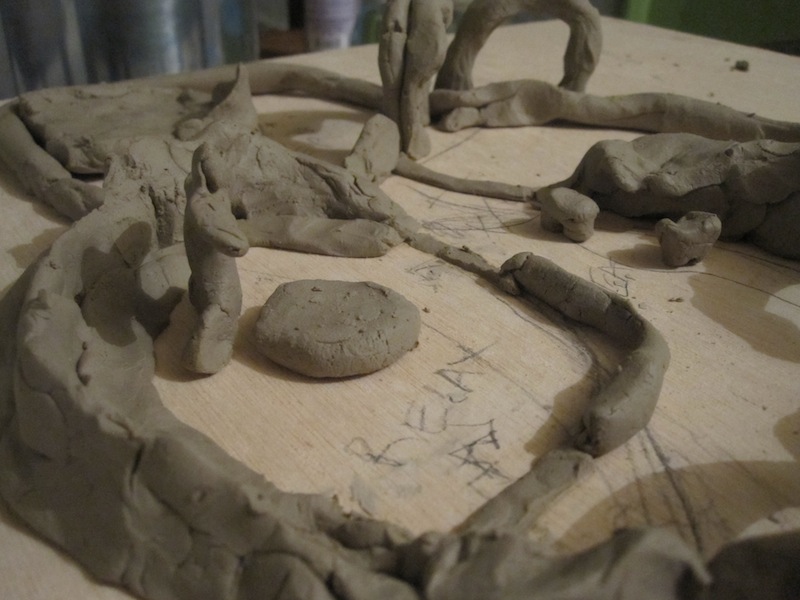
Meanwhile, now that the evening drive has been eliminated and we can sit down to discuss our ideas for the house we have finally had time to prepare a small model, more or less to scale. Here it is:

View of the bedroom, lounge, kitchenette, storage room and entrance -- facing south.

View of yoga room with human figurine for scale. Figurine represents a height of roughly 5'8" (172 cm). Yoga room is on a lower level than rest of house.

View of lounge with human figurine for scale. Lounge is also on a lower level.

Top view of house. North is the top of the plywood sheet, where the bedroom is. Yoga room to the east, entrance and storage to the south, lounge to the west.
View of entrance with human figurine for scale.

View of kitchenette with human figurine for scale.

Tuesday, August 13, 2013

Latitudinal Location Leavens Luxurious Allure

A short Astronomy primer for the Equator.

The location of Latitude and Longitude lines is measured in degrees (º), minutes (') and seconds ("). A standard measurement looks like this: 0º 28' 5,988".

1º is 69 miles or 111,2 km.
1º divided in 60 'minute' parts leaves 1,15 miles (1,853 km) per minute.
60' divided in 60 "second" parts leaves 0,019 miles (0,03 km) per second.

The standard measurement above --  0º 28' 5,988" -- is the location of the house in Chirimoyal, roughly 32,31 miles (51,99 km) North of the equator.

According to The Hand-Sculpted House, the degree above the horizon (the altitude) of the winter sun at noon can be calculated by subtracting the latitude of the site from the latitude of the Arctic Circle: 66º 33' 44". Amazingly, the arc of the winter sun throughout the day is also the path of the summer moon, which provides a second method for estimating solar and lunar location throughout the year.

Following the formula, the winter sun at noon above Chirimoyal has an altitude of

(66º 33' 44") - (0º 28' 5,988") = 66º 5' 38,012"
Equation for the winter sun at noon above Chirimoyal.

Using Find My Shadow I can verify that this equation is roughly accurate by comparing it to 
the location of the sun in mid December (66,183º) and mid January (67,680º).

Chirimoyal - Summer sunset


Reckoning the summer sun is done by adding 46º to the winter sun's position, but this is where the Astronomy becomes interesting and also where I had to do some research into the Astronomical implications of being on the Equator in order to understand where the Sun is throughout the year.

There are several wonders of being at the middle of the world.

First, light leaks from the sky much faster here than anywhere else. Far into the Northern or Southern hemisphere, the sun follows an oblique arc through the sky. When the sun sets it continues to move horizontally and vertically, tracing a slanted line and casting visible light into the growing dark for the duration of its perceived descent into the west.

On or near to the Equator, the sun travels close to directly overhead, in a relatively straight line with regard to the horizon. According to Euclid's "Triangle Inequality" proposition, 

In any triangle the sum of any two sides is greater than the remaining one.

This proposition is part of the statement that the shortest path between two points is a straight line. Whereas in the Northern and Southern hemispheres the sun does not follow a straight line toward the horizon, at the Equator the sun travels relatively directly across the sky and sets relatively perpendicularly with regard to the horizon. The period of descent is therefore more rapid and consequently the length of sunset much shorter at the Equator.

Second, while in the Northern and Southern hemispheres the sun appears to be higher or lower in the summer and winter seasons, on or near the Equator the sun is always high in the sky but passes between the south and north of the sky twice per year. From roughly April to September the sun is in the North, from October to March it is in the South.

Thereby in Chirimoyal we expect to find the summer sun above the southern horizon at

(66º 5' 38,012") + 46º = 112º 5' 38,012"
Equation for the summer sun at noon above Chirimoyal.

This is an obtuse angle -- greater than 90º -- and means, of course, that the summer sun is actually (180º - 112º 5' 38,012") = 67º 54' 21,988" above the northern horizon.

Sunday, July 21, 2013

Pathways towards Completion

Pathways, guides into the mystery of beyond, once infused with intent radiate a sacred presence into the very air around them. "Follow me," they promise, "for I lead somewhere."

Pathway to toilet foundations.
I worked on a pathway for all of the afternoon. It leads to the site of the dry toilet. The pathway is soft earth lined with stones. I finished construction for the day and walked along, inspecting my work. On the pathway I felt a tingling sensation up and down my spine, such as I have felt at midnight temples and tea-houses in Japan. Working ceaselessly as we are on restoring the old house to the fullest extent possible before the late august moon heralds arrival of a first volunteer; working slavishly on tiny details and in tiny spaces I forget our true purpose. The house, the house ! -- inside becomes my space and outside the wild, the foreboding, all prickly burrs and biting bugs. In placing the pathway I found my head. In placing the pathway I performed a first trick of magic on the site, mixing chaos and order to seed sacred serenity. Renewed, I delighted in the ecstasy of being.

Painting the walls green.
Boring though the recent renovation has been, constant commitment to the task at hand has allowed us to beautify the interior. We have painted the walls, white and lavender in the interior bedroom and white and new-leaf green in the main room. We have sealed the ceilings with plaster and silicon; before that we screwed fresh plywood to the rafters and made ceilings in the pantry and main room. I have hewed four legs for a bed frame from a 5m lumber pole. I have finished the first wood window frame and attached a tule cut to screen out the bugs.

Plywood ceiling.
Bed frame.

Slowly, steadily this temporary residence that has absorbed so much of our time is nearing completion!


Monday, July 8, 2013

There are no strings on me!


We knew the big challenge when Oscar left would be to work on the house while caring for Ainoa. At nine months of age she revolts against overlong rides in the baby carrier. Her crawling skills have improved to where leaving her sitting on the foam play-mat is out of the question as well. Our temporary solution is that Sandra has been taking care of Ainoa while I work on the house, though we try to switch roles and relieve each other during easily rotatable activities like painting.


Chirimoyal - Main room with netting tent
For some work rotation is simply not an option. When we have a task requiring us to combine our efforts and leave Ainoa alone for a short time we place her in a travel crib and try to focus on our work over her cries of frustration. Just two days ago she learned to pull herself up on the crib side and watch us work through the open doorway. This discovery and mastery of equilibrium has provided for a much calmer co-working time. We also have begun more keenly than before to feel the need for a large playpen which should give Ainoa sufficient space to exercise her burgeoning crawling and walking skills.

Chirimoyal - Painting the interior bedroom
On Wednesday we visited the elusive carpenter Juan and gave him measurements and descriptions for the playpen, using one piece of a set he had crafted for Valentin as a model. The 155 cm by 125 cm size will fit around the foam play-mat and the price, US $150, was in the range of 1 m^2 playpens we had inquired about at the Santa Clara market in Quito.

Once the interior bedroom has been completed, which may be as soon as July 6, we will move Ainoa in along with her new furniture and current anti-fly enclosure. We will continue to use the crib for positioning her around the house while we finish the interior.

For future outdoor work we have yet to develop a method, having however the outlines of a plan in mind. The basics of this plan are:
  1. Choose a visible location near or around the site and clear the ground. May involve levelling terrain.
  2. Install the bug-net equipped 3 m^2 tent on this location.
  3. Place the play-mat in the playpen under the tent.

Of course we shall have to evaluate the practicality of this plan once we begin construction of the dry toilet, our first big outdoor project. The final solution may keep us working at a slower pace, as does the current arrangement, but enjoying Ainoa’s ever more alert and active presence the day through is, for now, a welcome exchange.

Thursday, July 4, 2013

Magnum Opossum, Part One

When moving into an abandoned house, never assume the former tenants were human – or former.

Chota Valley - Repair works on the roof.
Twenty years is roughly how long the house in Chota had been derelict when we arrived in Ecuador last February. While inspecting the house for the first time we noticed a shoddy wooden food rack and two thin mats in the middle room which connects to the veranda. These obvious human artefacts put our minds at ease and led us to the assumption that natural processes had been kept at bay, at least somewhat, by the presence of people. Even if only a resting area for day labourers, we thought, the habit of the attentive species homo-sapiens to form a comfortable habitat could be relied upon to ward off complete re-assimilation of the house into the field. If we had taken the Mango tree seriously, we would have arrived at a very different judgement.


Chota valley - Stripping the ceiling 
Beside the front entrance to the house is an old Mango tree, the crown of which looks down upon all the land. I park the pickup truck in the shady nook between tree and house. We have trimmed the branches of this Mango tree several times to protect the house. In the beginning, the Mango tree was devouring the house; and an opossum was devouring the mangos.

Usually when something unexpected falls into one’s lap, one does not expect to be bitten: that is just what is unexpected. The worker we hired to repair the roof encountered an opossum in the rafters, startled, lost his footing and fell through the ceiling to the floor where he lay when the opossum fell on him, bit him, and scurried away. Or, as one version of the story went, he killed the opossum, worked the rest of the day, took the carcass home and had opossum for dinner. Whether we believed in escape or entrée, at least the opossum seemed to be a problem resolved.

Chota Valley - Covered in dirt
While we were back in Quito haggling over paperwork at the visa office, Oscar stayed on in Ibarra to continue working on the house. He soon heard scuffling and squeaks in the ceiling, starting daily around four in the afternoon. We returned and I went back to working on the house with Oscar. I didn’t hear what he had, however as we were about to fit a new ceiling into the interior bedroom and I thought removing the old, rotting plywood would make this easier, I suggested we have a look. Up the ladder I climbed, between the plywood boards I wedged a metal trowel, I pulled and down the board came. I was not prepared for the shit we found up there. Opossum turds, mango pits, dead leaves and corn cobs; detritus poured to the floor and rose billowing into a grey cloud until the walls of the room were invisible and I fled, coughing and brushing my eyes clean with the inside of my shirt. I resolved to buy an anti-dust respirator and goggles and continue the next day, which I did. When all strips of plywood had been brought to the ground and the grey dust hung low in the darkened room I surveyed my work. Several inches of debris covered the floor in a thick layer, hiding many of the plywood strips. Oscar came in with a broom; I took a shovel. All the refuse was enough to fill two large sacs formerly used for 50 kg of sand. We dug compost holes in the garden and emptied the sacs there.

Chota Valley - Stripped ceiling
Two days later I had stripped the plywood from every ceiling but the standalone room in which several weeks earlier we had installed the gypsum board sub-ceiling. I went through an entire anti-dust cartridge in the respirator and each time I finished a room I could feel the dust in my nose, in my mouth, on my skin. We had eliminated a potential Asthma risk for Ainoa but still we had not found the opossum. There were only three pieces of plywood left on the ceiling against one wall of the main room. We decided to leave those for the moment and continue putting in the new ceiling.